May 10, 2025
|
Uncategorised

Hereafter comes maybe the most controversial thing I’ve ever said.
I don’t think it matters if Santa is a woman.
Take a moment. Breath that statement in. Let the rage subside. Consider sharpening a knife for my skin as catharsis as you read on.
I don’t like Christmas. Yeah, I’m that person. ‘Bah hum-bug, no one invite this guy out, he’s a buzzkill’.
Thing is, the sentimentality of Christmas, I love it. Spending time with family, making people smile by giving them gifts, appreciating a festive feast and letting time slow down a little bit for a couple of days. I ain’t got no stance against that, if anything, as a society we should probably do it more than once a year, with a greater emphasis on the spending time together than the materialism.
But the branding of Christmas, it’s aesthetic identity. I can’t stand it. Bright reds coupled with garish greens. Putting a tree in your lounge. Glitter. Christmas cards. Elves. It’s just, urgh. And to top it all off, the figurehead of Christmas. Kris Kringle himself, Santa Claus.

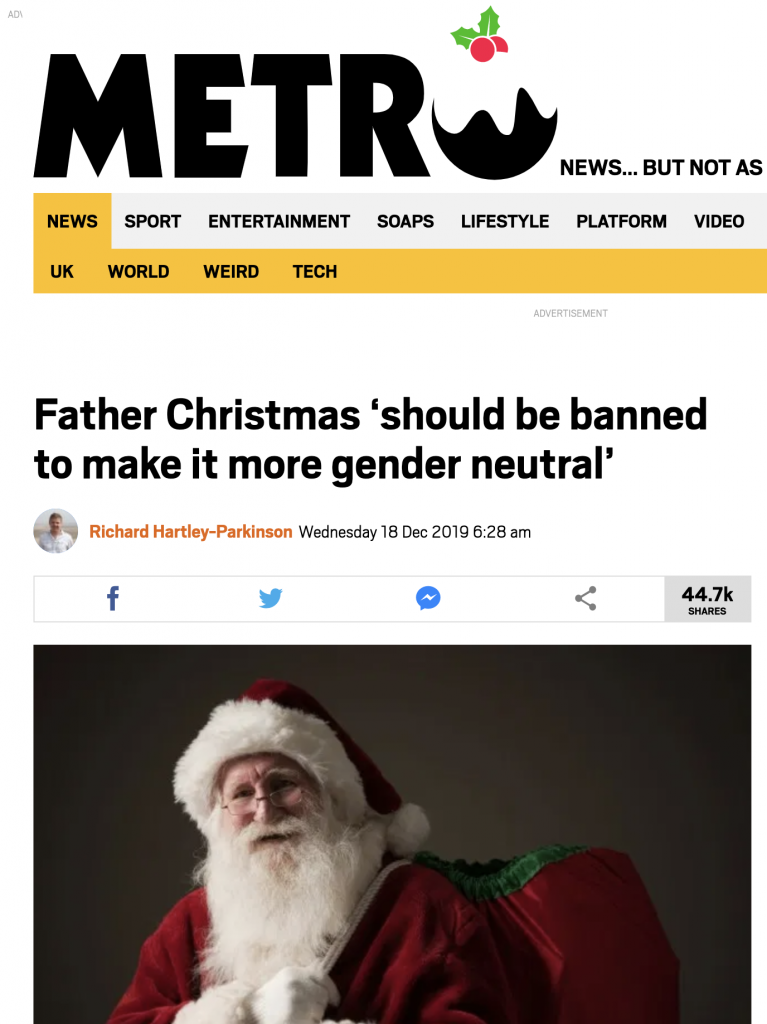
Now, the impetus of this article is reactive to some overwhelmingly negative feedback I’ve seen from people decrying the content of some click-bait article, suggesting that a collective of people think Santa should be ‘gender-neutral’, to keep up with today’s levels of inclusivity. I think the chief problem with the outrage here is that the words ‘gender-neutral’ conjure up contemporary issues relating to much more complex topics surrounding identity, our understandings of scientific reality and the laws by which we’ve lived for so long. I think, (maybe reaching a bit here), the idea of this hot topic reaching our steadfast and engrained ideas of Christmas represent something simple and joyous being changed, misrepresented, taken away. Gender politics just happens to be the in-vogue discussion right now; in another year maybe the exact same conversation and reaction revolves around Santa’s sexual preferences – could he be gay? Bi? Asexual?
I can understand where people’s aversions to Santa being changed come from. He’s a recognisable character from our childhood. A consistent memory of, for most of us, a happy time of year. Regardless of whatever else happens during the calendar, the seasonal arrival of a jolly, gift-giving, fat guy signifies nothing but positivity. That’s his whole thing, right? He judges the naughty, holding their Christmas haul at ransom in response to bad behaviour. Though, it’s somewhat of a baseless threat. I’d ask you to remember any time you ever saw Santa portrayed as anything but a friend to all, never angry, never upset, forever patient, the perfect…parent? Santa, to us, is simply a positive force. The idea, of Santa, is positivity.
But that’s where my assertation comes from, that Santa’s physical appearance, his biology, doesn’t matter. He isn’t a person, he’s an idea. For anyone under the age of 100, the perception of Santa is that of a rotund man in a red suit, black boots, big white beard and rosy cheeks. THAT, is the Santa people are keen not to see be changed. He’s a world-wide institution, damn it! You leave him alone. Except, no, no he isn’t. You’ve been born into this incarnation of him, which is why change to his appearance feels so destructive. And yet, we all know the history of Claus – at least somewhat. Santa comes from the legends of Saint Nicholas, a Turkish monk so revered and celebrated for his generosity and acts of charity that he became the patron saint of children. That historical figure from the Middle-East, (I may need to fact check this), but I don’t think he ever resided in the North Pole or had an entourage of magical pointy-eared, bell-shoed craftsmen.

In the early 1800’s stories of Santa made their way to New York, through Dutch immigrants, and documentation tells us that when he began to make it into the public consciousness he wasn’t adorned in trademark red. Records show that Santa was viewed in some instances as a ‘rascal’, whatever that’s supposed to infer, and was synonymous with a blue 3-cornered hat, red waistcoat and yellow trousers. Santa, as he was to some New York residents in the 1800’s, was a real fashion disaster.
The poem, ‘Twas The Night Before Christmas’ is where we get the majority of the identity of Santa as we know him now. This was a piece of verse written by an Episcopal minister for his daughters, to give an account of Saint Nicholas visiting children to reward their good behaviour. Funnily enough, this minister, Clement Clarke Moore, was initially hesitant about publishing the poem because of how much he took poetic license with the stories of the saint. If Moore had cared more about the sanctity of religious text, perhaps he wouldn’t have sent his work off, and our idea of Santa literally wouldn’t be what it is right now. Hell, we might not even have Santa. Imagine that. No, seriously, imagine that, because life really doesn’t change all that much without him.
‘Twas’ came out in the early 1800’s, but it wasn’t until 1863 that cartoonist Thomas Nast, for Harper’s Weekly, illustrated his interpretation of the character. Our perceptions of Santa’s behaviour come from a poem written from a father for his three daughters, and his iconic appearance come from a political cartoonist for a now-defunct magazine. Santa, I’m afraid to say, doesn’t transcend time. He’s not boundless, he is the construct of men who could never have possibly fathomed how far the popularity of their fanfiction would spread, nor how vigilant their readership would be to the idea of him changing, (despite the fact the version their fondness attaches to is the result of a lot of change).

Over the years, Santa has been adapted and changed, often for the benefit of companies looking to get your money. He went from charitable monk of children and fishermen, to magical good deed rewarder. From a man who became famous for being kind, to a man famous for flying through the sky on a sleigh pulled by supernatural reindeer. One caveat I’ll concede to this argument is that within everything we know and have absorbed about the stories of Santa, one thing is a consistent. He’s always portrayed as a man. Fair enough, you got me. My retort is simply this. Does it matter?
Why does it matter that Santa is a man? I guess you could say that it’s the gender-defining white beard, it’s pretty intrinsic to his character, and women don’t typically sport one so proud and cloud-like. Santa without a beard, now there’s a thought. Could you hazard to perceive a Christmas with a shaven Father Christmas? It’d be rubbish wouldn’t it? You might as well cancel Christmas. The food would taste worse, somehow. The gifts you receive from your family and friends would lose value inexplicably. Of course, I’m being overly sarcastic, because no, not a thing changes with the reality of the Christmas you experience because of how the fiction is presented.
I’m not saying we overhaul the construct of Santa Claus overnight. I’m just positing that it really doesn’t matter what Santa looks like now. He’s so far removed from the person he’s based on that to have him appear as another gender doesn’t really seem like much of a stretch. Remember, FLYING REINDEER. If you can accept that level of character retconning you should be pretty open to the idea of other changes.

Imagine being someone who helped spread the original tales of Saint Nicholas, wanting to perpetuate the idea that someone was so loved by so many simply by putting other people first and being generous. Now, imagine telling that same person (through a time machine let’s say), oh yeah, Saint Nic? Don’t worry, his legend lives on! Yes, over 1800 years later! Isn’t that great? I mean… he’s changed a bit of course, Chinese-whispers and all that. He’s very popular in the West so he’s been adapted a bit to fit our characteristics a bit more. That’s ok, right? Oh, also he’s no longer from Turkey, somewhere along the way he moved to the North Pole. But the charitable acts remain! That’s the important bit, ay? He visits children now and gives them gifts for being good. Not just some children either, ALL the children! How? Oh, well, he has this workshop where all the toys are made. No, he doesn’t make them, he has these elves that work for him. How many? I guess, I mean world population is 7.53 billion so I guess he’s probably got, like – look, don’t stress the details otherwise this all falls apart. Yes, elves, little pixie creatures that sing through their manual labour and are generally annoying. They work all year round to make the toys, then on Christmas eve he delivers them. Oh sorry, didn’t I mention? We merged the birth of Jesus Christ with this modern-day celebration of Santa Claus. I’m… I’m not sure why, I guess it streamlined things? ‘Santa’, yeah. Oh right, so ok, ‘Saint Nicholas’ wasn’t really working, you see, and some people from Holland living in New York were super into him around the 1800’s and they called him, ‘Sinter Klass’, but that didn’t roll off the tongue so well in America, so we changed it to Santa Claus! How does he deliver the presents to children all over the world? He..err..He flies. How? By, um, reindeer… No, no, it’s ok, you take a seat, do you need some water? I realise I’ve dumped a load of nonsense on you there. What’s that? Do people still know about the original Saint Nicholas throughout all his changes? Umm, some do. Not… everyone, but some… probably? Companies love using his image, so he’s all over things to buy this time of year, and it’s his image that lives on more than his story, which, hmm, maybe isn’t what you wanted to hear…
–
It’s obscene how much the identity of Santa Claus has changed. In 100 years, I guarantee he’s different to how he is right now, and if you’re someone angered by the potential of Santa growing a pair of breasts, then when you die we should hook up some gyros to you or something, because the amount of spinning you’re gonna do in your grave over the next several thousand years is, by my estimations, enough to provide power to most of the world. But hey, what a beautiful act of charity that would be, Santa would live on through you!
Santa Claus, and his attached identity, are about as important as Dr Who. I don’t say that condescendingly, but he’s literally as important to Christmas as you want him to be. In a few years, though perhaps not few enough, people will look back at the absolute mouth-breathers that decried the idea of a female Dr Who with confusion and pity. ‘But why were they so upset about the fictional sci-fi character being a woman?’ We’re not sure, child, but we think this point of view might have occurred during a blissful period of history where everything else in the world was so overwhelmingly fine that there was nothing else to do BUT get annoyed about the legacy of a British TV show.
–
Christmas isn’t about Santa, it’s about your family, and however you define that word. It’s about giving. Importantly, if Saint Nicholas’ memory amounts to anything this time of year, it’s about those less fortunate. OG Santa wasn’t the patron Saint of consumerism. His entire legend is built on him giving and spreading the ideology that we should try and be nicer to each other. That’s why I don’t like Christmas. The annual stress is a sign that such a mentality has been largely diluted. Yes, receiving gifts feels nice, and strengthening any relationship by gift-giving, showing your awareness and consideration of someone else, is an important part of life . But the idea of Christmas, to me at least, is perverse in its current iteration. I don’t have a problem with people enjoying some escapism in the form of a fictional character to entertain children. But here’s the thing, you know you don’t have to use Santa? You can create your own fictions for your children; such is the power of imagination. Why do we have to be married to someone else’s fictional creation? If I’m honest, I think the idea of Santa doesn’t have much staying power with how the world is developing anyway. How do you make a child believe in magic when they have Google? But that’s fine, to me, because Santa is representative of a different time in our lives, much like how Disney means something different to millennials than it does to younger generations growing up now. Why are we so insistent on maintaining Christmas as a stressful experience? Collectively, we could scrap gift giving on the 25th altogether, since relatively, compared to Christmases of decades past, we have so much stuff already that to get things on Christmas is, quite literally, just excess. Why not make Christmas exclusively about spending time together, rather than spending money. Hell, here’s a mad thought, in honour of Santa Claus, why not make Christmas a time of year where we only give money and gifts to charity?
I get it, Christmas represents the joy of indulgence, and I completely empathise with parents who were once children without a bountiful Christmas and use this holiday as a chance to show their children the complete opposite. We live in a world though where we’re so acutely aware of our impact on the environment, and it feels like all of the anti-plastic measurements we adopt January to November go out the window when Christmas comes knocking. Oh, you’re allowed to take a week or so off for Christmas, no one messes with that one, that’s sacred. Honestly, how we haven’t outlawed crackers at this point is beyond me; no one enjoys the cheap toys and if you want awful jokes I’m sure Michael McIntyre will always be on the TV later.

Christmas is a time for children, they’re the ones who benefit from the magic and whimsy of it. Does a child truly care if Santa is a circular man in red, a weird hipster with yellow trousers, a woman in a cape and hood, or a mischievous talking giraffe? Surely, the point is that we use any narrative of Christmas to spread the ideas of good will, positivity and generosity. How the vessel we choose to tell this story looks really doesn’t matter. That you grew up with one iteration of the character doesn’t make them sacrosanct against any other. Things change, especially Santa Claus. Maybe Santa doesn’t matter anymore, because it’s much more important to show our children that the actual humans here, in the flesh, are capable of such beneficial characteristics. Rather than Santa be a standout because of exceptional kindness, with the disclaimer that oh, ‘he’s magic’, maybe parents working overtime, extra shifts, extra jobs, and putting hours in to providing for their kids are the real heroes of Christmas. So yeah, maybe Santa’s a man. Maybe Santa becomes a woman. Maybe we stop for a minute and consider what role Santa actually plays in our society now, and change him accordingly, since who he was to you, product of the 1900’s, isn’t what he is to a child of the 2010’s, nor what he’ll be to offspring born in the next decade.
–
It’s just worth remembering that tradition isn’t ironclad. We can have our traditions as a society, but also our own as individuals and small units; our own values and our own celebrations. Santa might as well be public domain at this time. If a family somewhere wants to tell their children that Santa is a woman, I say let them. Considering that 90% of where we see Santa is on adverts, ask yourself why it matters that he be a man? In 2019 he’s a tool used to sell things, and if the origins of Santa matter that much to you, why not tell your children about Saint Nicholas instead? Inspire them to live a life of empathy and consideration for others, not just have them associate December the 25th as a day when they get more things.
Personally, if we’re changing the idea of Saint Nick, I’m in for ‘Socially Conscious Santa’ who gives children gifts to give to others, or sums of money to give to a charity that said child feels a connection towards.
Merry Christmas,
John (now forever on Santa’s Naughty List)